
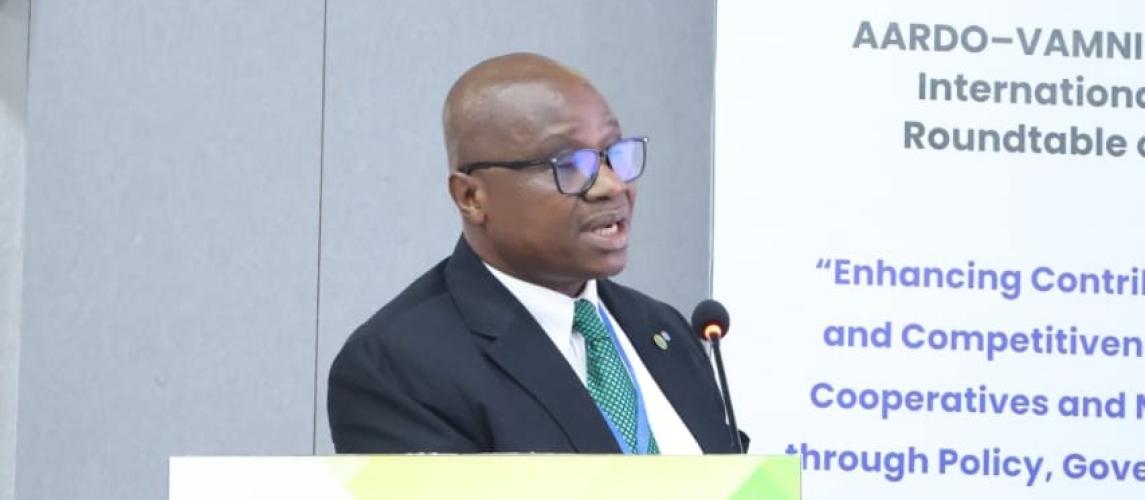
Remarks By Hon. Edward Mulbah, Deputy Minister Ministry of Internal Affairs, Republic of Liberia At the Roundtable Meeting on “Enhancing Contributions and Competitiveness of Cooperatives and SMEs through Policy, Governance and Technology Interventions”.
Remarks By Hon. Edward Mulbah, Deputy Minister, Ministry of Internal Affairs, Republic of Liberia
At the Roundtable Meeting on “Enhancing Contributions and Competitiveness of Cooperatives and SMEs through Policy, Governance and Technology Interventions” VAMNICOM, Pune, India.
01–06 December 2025
December, 2, 2025
H.E. Dr. Manoj Nardeosingh, Secretary General, AARDO
Honourable Chief Guest, Mr. Shaji V. K., Chairman, NABARD
Dr. Suva Kanta Mohanty, Director, VAMNICOM
Mr. Abdoulie Njai, Parliamentarian, The Gambia
Eminent resource persons, distinguished delegates, guests, and participants from AARDO member countries,
Ladies and gentlemen,
Excellencies, distinguished delegates, development partners, colleagues, ladies and gentlemen,
It is a great privilege to address this Roundtable at a time when our national economies—particularly across Africa and Asia—are navigating complex transitions shaped by global uncertainties, demographic change, and the rapid advancement of technology. I express my sincere appreciation to AARDO and our host institutions for convening this important platform that brings together policymakers, practitioners, and experts to reflect on the evolving role of cooperatives and SMEs as engines of inclusive and sustainable development.
Across Liberia, cooperatives and SMEs play a foundational role in our socio-economic architecture. They are central to agriculture, rural commerce, food processing, fisheries, artisanal crafts, and emerging service sectors. They provide livelihoods for thousands of households, stimulate decentralized economic activity, and enhance the resilience of local communities.
Cooperatives, in particular, promote equitable resource distribution, collective bargaining, and structured engagement between rural producers and formal markets. These characteristics make cooperatives indispensable instruments for rural transformation, household income stability, and the strengthening of social cohesion.
Strengthening Governance and Institutional Frameworks
For cooperatives and SMEs to realize their full potential, institutional and governance reforms are essential. Many entities continue to confront challenges such as inadequate governance structures, limited managerial capacity, low financial literacy, and weak compliance systems.
To address these constraints, the Government of Liberia has prioritized reforms that include:
Modernizing cooperative laws and regulatory standards
Establishing transparent oversight and audit mechanisms
Strengthening coordination between central and local government institutions
Expanding public–private partnerships to support SME growth
Professionalizing cooperative leadership and management structures
These reforms aim to build a coherent and supportive ecosystem that promotes innovation, accountability, and sustainable enterprise expansion.
Harnessing Technology to Enhance Competitiveness
Technological adoption is now a prerequisite for competitiveness. Digital tools can expand market access, improve productivity, reduce transaction costs, enhance supply-chain visibility, and strengthen financial inclusion.
In Liberia, mobile technologies and ICT platforms are increasingly integrated into agricultural extension services, microfinance systems, business registration processes, and e-commerce networks.
To build a digitally ready cooperative and SME sector, Liberia is accelerating efforts to:
Expand digital skills training
Promote digital payment systems
Support ICT-enabled agribusiness solutions
Partner with technology firms to deploy market information systems
Improve broadband connectivity in rural areas
These investments are essential to ensuring that cooperatives and SMEs remain competitive within regional and global value chains.
Women, Youth, and Inclusive Enterprise Development
Women and youth are central to Liberia’s national development agenda. Women-led cooperatives are thriving in agriculture, food processing, textiles, soap-making, and community enterprises. Similarly, Liberian youth continue to show tremendous innovation in digital services, agritech start-ups, hospitality, and creative industries.
To unlock their full potential, Liberia is strengthening:
Women’s entrepreneurship financing mechanisms
Youth innovation labs and incubation hubs
Capacity-building programmes on digital and managerial competencies
Value-chain linkages supporting rural and peri-urban enterprises
Supporting women and youth is not only a social imperative—it is a strategic investment in our nation’s productive capacity and long-term economic competitiveness.
Ladies and gentlemen,
Allow me to underline Liberia’s deep and constructive partnership with the African-Asian Rural Development Organization (AARDO). Our collaboration spans decades and has significantly contributed to institutional development, local governance strengthening, and capacity enhancement for Liberian professionals addressing rural development challenges.
Through AARDO’s scholarship schemes, training programmes, and capacity-building workshops, hundreds of Liberian officials, technicians, and practitioners have been trained in areas including cooperative management, agricultural modernization, water resource development, local governance, community-driven development, rural infrastructure, and climate resilience. In the last decade alone, approximately 45 Liberian participants have benefited from these programmes.
This partnership has strengthened evidence-based policymaking, improved development planning frameworks, and supported key institutional reforms across the Ministry of Internal Affairs and other sectors. AARDO’s South–South cooperation platform continues to provide Liberia with exposure to innovative models and best practices from Asia, the Middle East, and across Africa—creating opportunities for replication and adaptation at community levels.
Liberia highly values this partnership and remains committed to expanding joint initiatives in digital transformation, cooperative strengthening, and youth-focused rural enterprise development. AARDO remains not only a partner, but a catalyst for institutional growth and a vital bridge for intercontinental knowledge exchange.
Conclusion
As we reflect on the theme of this Roundtable—enhancing contributions and competitiveness through policy, governance, and technology—it is clear that sustained progress requires coordinated action, robust institutions, and a firm commitment to innovation and inclusiveness.
Liberia stands ready to deepen collaboration with AARDO, regional institutions, and international partners to strengthen cooperative systems, improve SME competitiveness, and build resilient community economies capable of withstanding emerging global challenges.
I thank you.
